
Mid-infrared photonics and its applications is the subject of this blog article.
Introduction
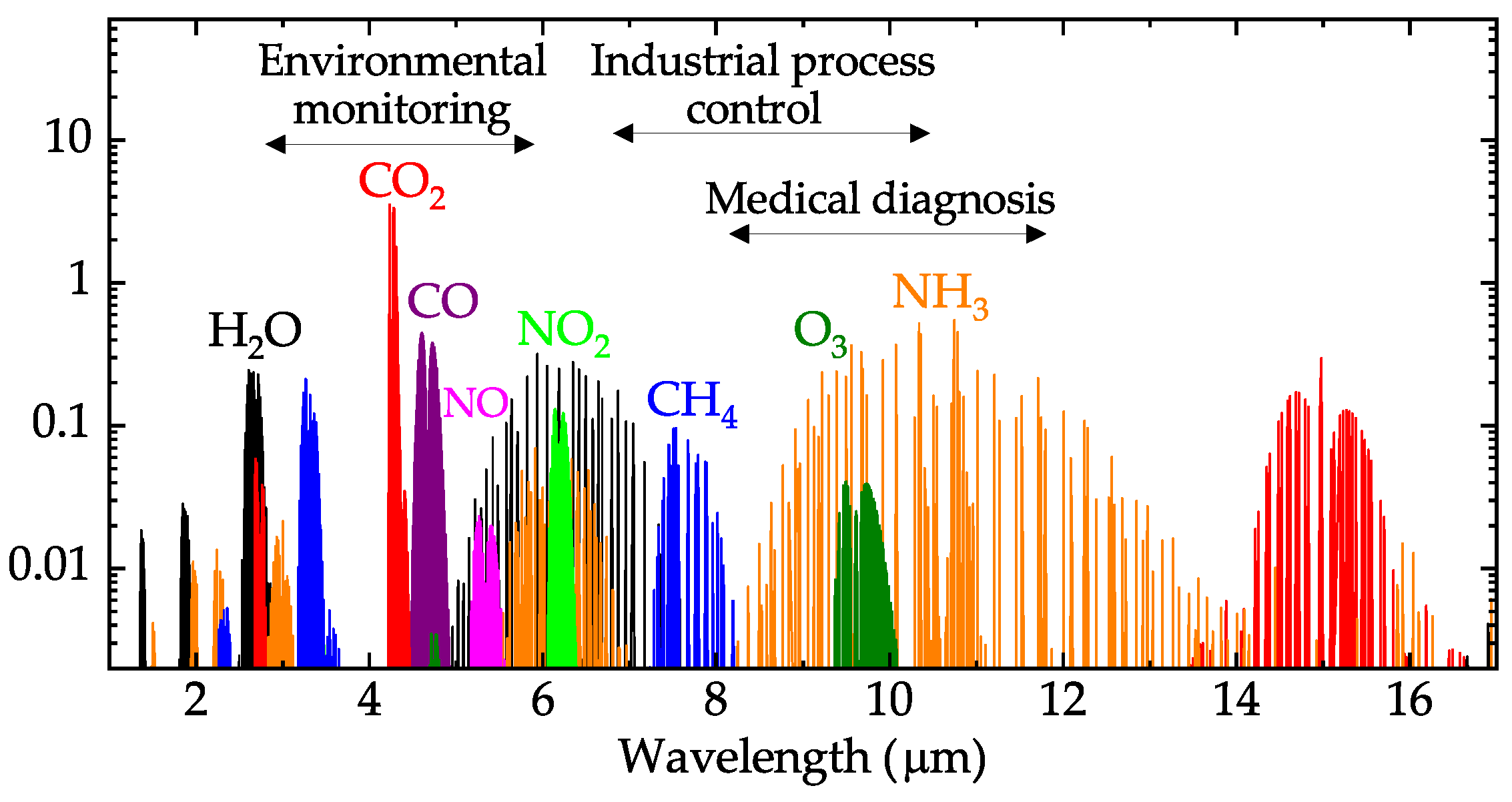
The mid-infrared (MIR) spectral range, typically spanning wavelengths from 2 to 20 μm, has long been recognized as one of the most information-rich regions of the electromagnetic spectrum. Often called the “molecular fingerprint region” it is where most molecules exhibit their strongest vibrational absorption bands, allowing for the precise identification of chemical species.
In recent years, mid-infrared photonics has evolved from laboratory curiosity into a driving force behind practical applications in environmental monitoring, industrial safety, and defense systems. The development of compact MIR laser sources, sensitive detectors, and photonic integration has opened new frontiers for real-time, high-sensitivity sensing on the ground, in the air, and even in space.
The Science Behind Mid-Infrared Photonics
Understanding the MIR Spectrum
Positioned between the near-infrared (NIR) and far-infrared (FIR) regions, the MIR band is uniquely suited for identifying molecular compositions. Within this window, light interacts strongly with fundamental molecular vibrations stretching and bending modes of chemical bonds such as C–H, N–H, and O–H. These interactions form distinct absorption patterns, enabling detailed chemical analysis without the need for sample contact or preparation.
Unlike visible or near-infrared systems, MIR sensing provides quantitative and selective information, which makes it indispensable for trace gas detection, pollution monitoring, and biomedical diagnostics.
Advances in MIR Light Sources and Detectors
Historically, the lack of compact and efficient MIR sources was a major limitation. Traditional blackbody emitters and gas lasers were bulky and energy hungry. That changed with the advent of Quantum Cascade Lasers (QCLs) and Interband Cascade Lasers (ICLs), both capable of generating high-power, tunable MIR radiation in small, rugged packages.
- Quantum Cascade Lasers (QCLs): Semiconductor lasers that use intersubband transitions in quantum wells. They can be precisely tuned to target specific absorption lines of gases like CO₂, CH₄, or NO₂.
- Interband Cascade Lasers (ICLs): Offer lower power consumption and are ideal for portable or battery-powered MIR sensors.
Complementing these are advanced MIR detectors, such as HgCdTe (MCT) and InSb photodiodes, as well as uncooled bolometers and silicon-based photonic detectors enhanced through plasmonic or metamaterial designs. These innovations have made MIR instruments faster, smaller, and more accessible for widespread deployment.
Environmental Monitoring Applications
Atmospheric Gas Detection
One of the most powerful applications of MIR photonics lies in trace gas detection for environmental monitoring. Because gases such as CO₂, CH₄, NOₓ, and volatile organic compounds (VOCs) have strong absorption features in the mid-infrared, spectroscopy in this range allows for extremely sensitive and selective measurement.
MIR-based systems can detect gases at parts-per-billion (ppb) concentrations, making them ideal for air quality assessments, climate research, and industrial emission monitoring. Portable open-path FTIR spectrometers and QCL-based gas analyzers are now widely used by environmental agencies and industrial facilities to monitor greenhouse gases and pollutants in real time.
Industrial and Agricultural Sensing
Mid-infrared technologies are also being applied to monitor industrial processes from combustion efficiency in power plants to leak detection in chemical manufacturing. By analyzing the infrared spectra of exhaust gases, operators can fine-tune systems for optimal performance and reduced emissions.
In agriculture, MIR hyperspectral imaging enables non-destructive assessment of soil quality, crop health, and contamination levels. For example, MIR reflectance spectrum can reveal nutrient deficiencies or pesticide residues, helping farmers implement precision agriculture practices.
Mid-Infrared Photonics in Defense and Security
Chemical and Biological Threat Detection
In defense and homeland security, MIR photonics is emerging as a cornerstone technology for chemical and biological threat detection. Many toxic substances, including chemical warfare agents, explosives, and hazardous industrial compounds, exhibit distinct MIR spectral fingerprints.
Using tunable MIR lasers such as QCLs, standoff detection systems can identify trace quantities of these compounds at distances of tens or even hundreds of meters. These systems rely on techniques such as laser absorption spectroscopy, photoacoustic detection, or laser-induced fluorescence to deliver rapid, non-contact identification of dangerous materials.
Thermal Imaging and Target Recognition
The MIR band also overlaps with the thermal infrared range (particularly 3–5 μm and 8–12 μm), which is critical for thermal imaging and target acquisition. Modern defense systems use MIR photonic sensors for applications such as:
- Night vision and surveillance under complete darkness
- Missile guidance and target tracking via heat signatures
- Infrared countermeasure systems that detect and deflect incoming threats
Advancements in quantum well infrared photodetectors (QWIPs), superlattice detectors, and on-chip MIR optics have dramatically improved resolution and response time, while reducing size and power requirements.
Additional Use Cases of Mid-Infrared Photonics
Beyond environmental sensing and defense applications, mid-infrared (MIR) photonics is proving to be a transformative technology across multiple scientific and industrial domains. As MIR lasers, detectors, and integrated platforms continue to evolve, new frontiers of application are opening up in healthcare, manufacturing, agriculture, and even space exploration.
1. Biomedical Diagnostics and Therapeutics
Mid-infrared light offers a unique window into biological materials because many key biomolecules, such as proteins, lipids, and nucleic acids, exhibit strong absorption bands in this region.
Spectroscopic fingerprinting: MIR spectroscopy enables non-invasive detection of metabolic markers in breath or blood, supporting early diagnosis of conditions such as diabetes, cancer, and liver disorders.
Laser-assisted therapy: Certain wavelengths in the MIR range are being explored for photothermal and photodynamic therapies, where they can selectively target tissues with minimal collateral damage.
Imaging and tissue analysis: MIR microscopy can provide label-free imaging of cells and tissues, offering richer biochemical insight than visible or near-IR imaging methods.
2. Industrial Quality Control and Manufacturing
In industrial environments, MIR photonics is being adopted for precision process monitoring and material characterization.
Polymer and coating inspection: Many plastics and composite materials have characteristic MIR absorption bands, allowing manufacturers to assess chemical uniformity and detect defects in coatings or films.
Additive manufacturing: MIR sensors can monitor powder-bed fusion and resin-curing processes in real time, improving the reproducibility of 3D-printed components.
Semiconductor fabrication: Mid-infrared spectroscopy helps track thin-film deposition, contamination, and gas-phase reactions in photonic and microelectronic production lines.
3. Agricultural and Food Safety Monitoring
MIR spectroscopy is becoming an essential analytical tool for sustainable agriculture and food quality assurance.
Soil and crop health: MIR remote sensors can identify nutrient content and moisture levels, enabling data-driven irrigation and fertilization strategies.
Food composition analysis: MIR absorption spectra can reveal fat, sugar, and protein concentrations in processed food products without sample destruction.
Contaminant detection: MIR photonics can rapidly identify pesticide residues or microbial contamination, improving supply chain safety.
4. Space Science and Planetary Exploration
In astrophysics and planetary science, MIR photonics helps scientists uncover the chemical and thermal characteristics of celestial bodies.
Exoplanet studies: Space observatories such as the James Webb Space Telescope (JWST) use MIR spectrometers to analyze exoplanet atmospheres, detecting gases like methane, carbon dioxide, and water vapor.
Planetary surface analysis: MIR instruments on landers and rovers can characterize minerals and detect trace volatiles on the Moon, Mars, and icy moons.
Astronomical imaging: MIR interferometry improves resolution for observing dust clouds, star formation regions, and protoplanetary disks.
5. Telecommunications and Optical Interconnects
As optical communication systems approach the limits of near-infrared operation, the mid-infrared spectrum is gaining attention for next-generation data transmission.
Mid-IR waveguides: Silicon, germanium, and chalcogenide photonic platforms enable low-loss transmission beyond 2 µm.
Free-space optical links: MIR wavelengths can offer better atmospheric transmission windows in certain environments, potentially expanding secure or long-range communications.
Spectrally efficient multiplexing: Using MIR bands can relieve congestion in existing telecom infrastructure, paving the way for high-capacity optical networks.
Summary
These emerging use cases demonstrate how mid-infrared photonics is not confined to niche laboratory research — it is rapidly becoming a foundational technology for industries as diverse as biomedicine, manufacturing, and planetary science. As MIR components continue to shrink in size and cost, their integration into compact sensors, spectrometers, and imaging systems will further expand the frontiers of what’s measurable, monitorable, and knowable through light.
Integration Trends and Future Outlook
The next frontier in MIR photonics lies in integration and miniaturization. The emergence of Mid-Infrared Photonic Integrated Circuits (PICs) is paving the way for compact, chip-scale systems that combine light sources, modulators, waveguides, and detectors on a single substrate.
These integrated MIR platforms promise:
- Portable sensing devices for field deployment and IoT environmental nodes
- Mass-producible, low-cost systems for industrial and defense use
- Improved robustness through solid-state integration and fewer moving parts
Another major trend is the integration of MIR sensing with AI-driven data analytics. Machine learning models can analyze spectral data to automatically identify chemical compounds or detect anomalies in complex environments significantly reducing human interpretation time and error.
Researchers are also exploring new materials such as silicon-germanium, chalcogenide glasses, and III-V semiconductors to improve transparency and functionality in the MIR region. Together, these advances are positioning MIR photonics as a cornerstone of next-generation sensing technologies.
Conclusion
From tracking greenhouse gases to identifying hazardous materials and enhancing battlefield awareness, mid-infrared photonics is redefining how we see and sense our world. Its unique ability to capture the molecular and thermal “fingerprints” of matter makes it indispensable for environmental, industrial, and defense applications alike.
As technologies like quantum cascade lasers, integrated MIR chips, and AI-enhanced spectral analysis continue to mature, the reach of MIR photonics will only expand, bringing us closer to a future where precise, real-time optical sensing becomes a foundational tool for a safer and more sustainable planet.
Further Reading
- Faist, J. et al. “Quantum Cascade Lasers.” Science, Vol. 264, No. 5158, 1994, pp. 553–556.
— A foundational paper introducing the concept and operation of quantum cascade lasers, now central to mid-infrared photonics. - Razeghi, M., and Nguyen, B.-M. “Advances in Mid-Infrared Detection and Imaging: A Key Technology for Homeland Security and Defense.” Proceedings of SPIE, Vol. 8268, 2012.
— Explores progress in MIR detector materials and architectures, including QWIPs and superlattice detectors. - Tittel, F. K., Richter, D., and Fried, A. “Mid-Infrared Laser Applications in Spectroscopy.” In Solid-State Mid-Infrared Laser Sources, Springer, 2003, pp. 445–510.
— A comprehensive overview of MIR laser spectroscopy and its applications in gas sensing and environmental monitoring. - Curl, R. F., Capasso, F., Gmachl, C., et al. “Quantum Cascade Lasers in Chemical Physics.” Chemical Physics Letters, Vol. 487, No. 1–3, 2010, pp. 1–18.
— A detailed discussion of how QCLs have enabled highly sensitive detection of atmospheric and industrial gases. - Karim, M. F., and Singh, P. K. “Mid-Infrared Photonics: Materials, Devices, and Applications.” Opto-Electronics Review, Vol. 29, No. 3, 2021, pp. 151–168.
— A recent review summarizing emerging trends in MIR materials, integrated optics, and photonic circuits. - National Institute of Standards and Technology (NIST). “Spectroscopic Data for Environmental Monitoring.” NIST Chemistry WebBook, 2023.
— Reference database of absorption spectra and molecular fingerprints relevant to MIR sensing. - SPIE Newsroom. “Mid-Infrared Photonics for Chemical Sensing.” SPIE Spotlight Article, 2022.
— Overview of current commercial and research developments in MIR sensing systems for environmental and security applications.


